- Why decks written mostly by AI take investors longer to read, and why that counts against you
- The giveaways investors spot: repetition, fluff and classic AI phrasing
- What stands out instead: insight only you have, depth, your team and trust
- A simple test for using AI without losing your own story
More than 1,000 startups have joined ThatRound, so we see a lot of pitch decks. And over the past few months, we’ve noticed a clear rise in decks that have been largely written by AI.
That isn’t a bad thing in itself. Some of the strongest decks we see have had AI involved, because the founder did the thinking and used AI to help present it. This post isn’t about those. It’s about the decks where AI has basically done all the thinking too, and those are getting easier to spot. Investors are noticing, and it’s slowly changing what they look for in a deck.
Why lazy AI decks work against you
Lazy AI decks with bloated information can take investors longer to read, and that time counts against you.
An angel network lead we spoke to recently told us that their network saw more than 1,600 applications last year, and volume isn’t the issue for them. The issue is that AI-generated decks are more plausible on the surface, so every “no” now takes an extra five or six minutes to reach. Across that many applications, that’s a lot of time spent working out whether there’s a real business underneath.
When investors have to dig harder for the story and the key message, the decks that make this easy to find stand out even more.
What gives an AI-generated deck away
You’d think a well-made AI deck would be hard to spot, but one built without much thought is fairly easy to notice. Investors on a panel at Climb26 this summer said the same: a purely AI-generated deck can be obvious the moment it’s opened, as we covered in how investors and founders use AI in fundraising [1].
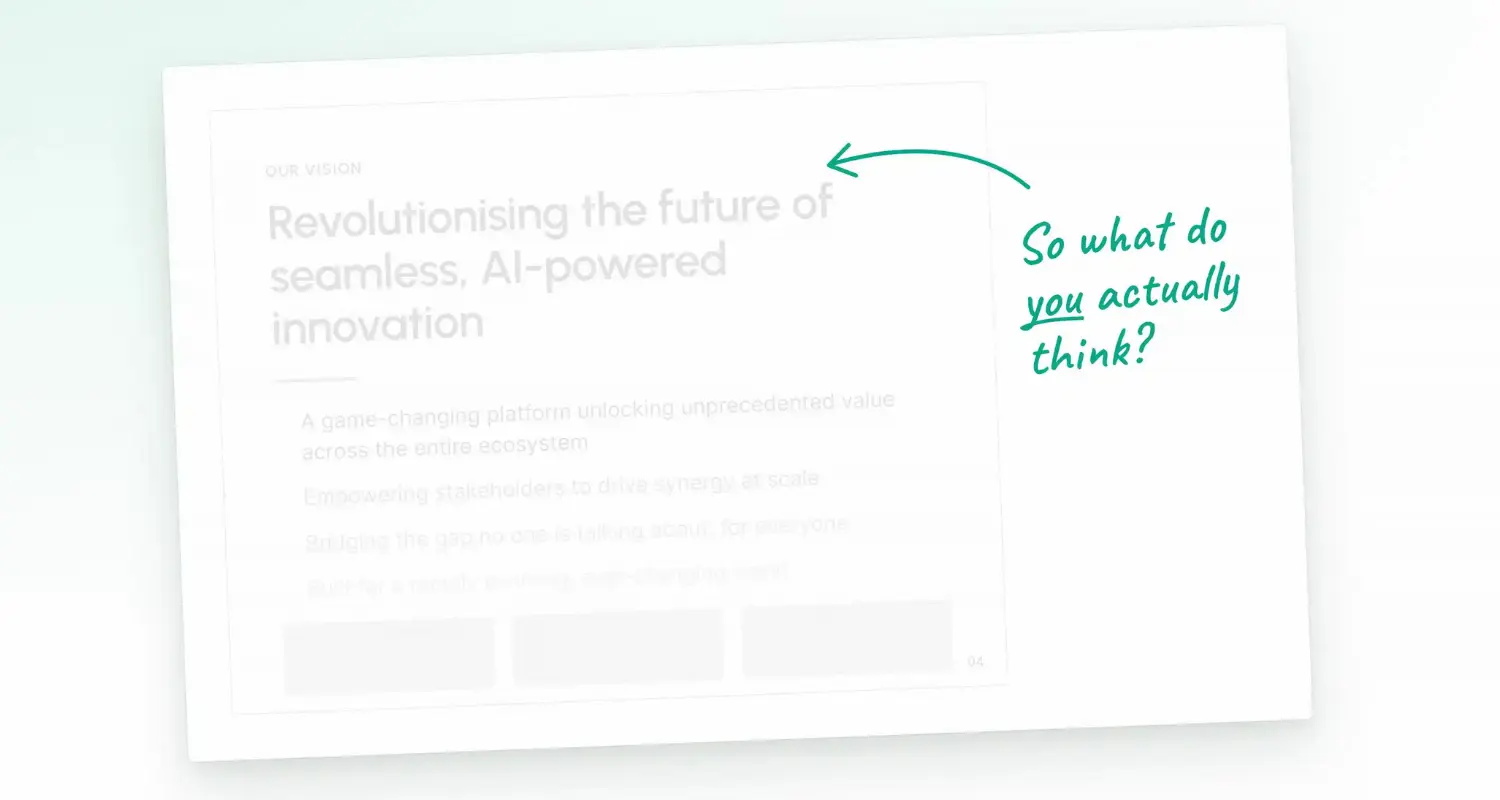
The first giveaway is unnecessary repetition. The same point turns up on the problem slide, again on the solution slide and once more in the summary, just worded slightly differently. The second is fluff: sentences that sound right, but don’t say anything specific about this company. You can end up with a lot of information and not much depth, or sentences that need re-reading to let the point sink in.
A phrase that contains classic AI wording, like “That’s the gap no one’s talking about”, or a slide heading that doesn’t quite make sense for the business, can put the investor’s guard up. From there, they’re reading the rest of the deck trying to decode which parts the founder actually thinks, and that’s not where you want a first read to start.
The basics still stand
None of this means the fundamentals of a good pitch deck have changed [2]. It still needs a story. It still needs a clear problem, a clear reason you’re the one solving it, and evidence behind your claims. That’s exactly the part AI struggles to produce on its own, because the story comes from you.
What has changed is what polish tells an investor. The decks coming through ThatRound look better designed than they ever have, and that’s partly down to AI. But when anyone can produce clean, well-structured slides in an afternoon, a tidy deck is the baseline rather than the thing that sets you apart.
What investors look for instead
When AI can make any deck look polished, the things that stand out are the ones it can’t produce for you:
- Something only you could know. An insight from years working in your industry, data from your own customers or a pattern you spotted before anyone else. AI can summarise a market, but it can’t tell an investor what you learned from being inside it
- Depth over breadth. The decks that stand out to me are the ones where the founder clearly knows their subject inside out. A focussed deck that goes deep on a few things beats a long one that skims everything
- Who you are and why you’re building this. Your team and your reason for tackling this problem are often the first things an investor wants to understand, so make them easy to find
- Trust. Warm introductions were already valuable, and I’d expect them to count for even more now, because they come with a real person vouching for you
How to use AI without losing yourself in it
I’m by no means saying to stop using AI, but I’m asking you to question what you hand over to it and how it’s used.
Before AI goes anywhere near your deck, you should already know your narrative, your story and your customers. You should have the insight and the data to back up every claim you make. That part has to come from you, because it’s what an investor is actually backing.
Once you’ve got it, AI is useful for the rest. Use it to refine your wording, sense-check your numbers, present things more clearly and pressure-test your deck the way an investor would. What it can’t do is build a quality deck for you from scratch if you don’t yet know what should be in it.
One simple test before you send anything: go through each line and ask whether you could defend it on a call without notes. If you couldn’t, it’s either not yours or not true yet, so cut it.
The deck has never been the entire story
A deck has always been a compressed version of a company, and AI makes it easier to fill that space without saying much. It’s part of why we collect more than the deck when a startup joins ThatRound, so investors see the context behind the slides.
Wherever you’re raising, though, the principle is the same. Investors aren’t really asking whether your deck looks good. They’re asking whether you know something they need to hear. Make sure that’s obvious by the second slide.
If you’re getting ready to raise, we’ve recently launched a free way to check where you stand before that deck goes anywhere. Get your free Investor Fit Snapshot and we’ll check your deck and company details against 500+ VCs, angel networks and syndicates.
You’ll see where your round sits, what’s working for you and what’s stopping more investors from being a fit. It’s an estimate, not a guarantee of investment, and no investor sees your deck at this stage.
References
- How investors and founders use AI in fundraising | ThatRound | https://www.thatround.com/post/how-investors-and-founders-use-ai-in-fundraising
- The ultimate guide to writing a winning startup pitch deck | ThatRound | https://www.thatround.com/post/the-ultimate-guide-to-writing-a-winning-startup-pitch-deck